
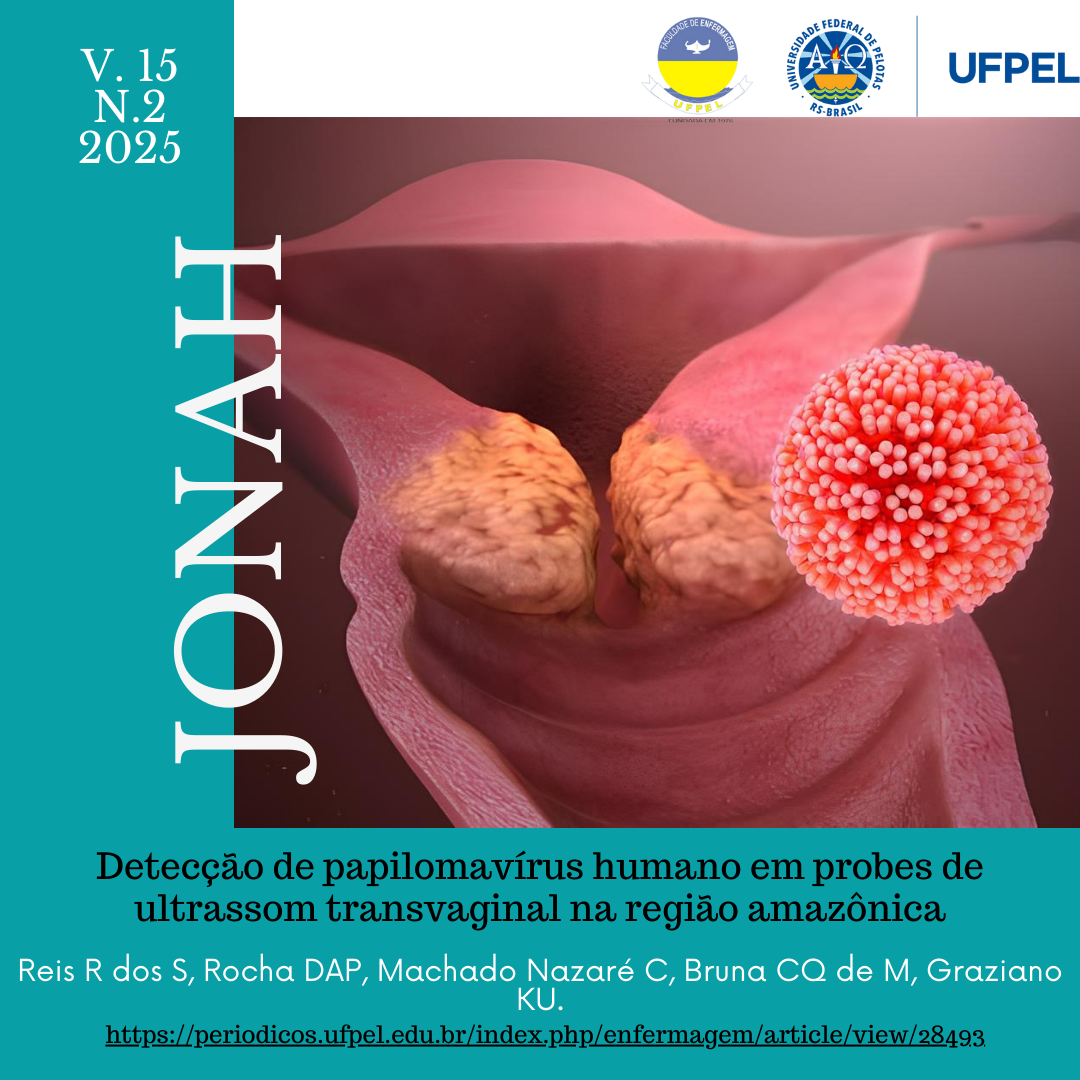
Detecção de papilomavírus humano em probes de ultrassom transvaginal na região amazônica
Resumo
Objetivo: verificar a presença de ácido desoxirribonucleico do Papilomavírus Humano em probes de ultrassom transvaginal. Método: estudo observacional, em que amostras foram coletadas das superfícies dos preservativos e probe transvaginal após exames realizados em 30 mulheres da região amazônica. Foram incluídas todas as utilizações do probe de ultrassom dos exames transvaginais realizados durante o período do estudo. Resultados: ácido desoxirribonucleico humano foi detectado em todas as amostras colhidas dos preservativos e, em 8 (26,6%) amostras, foi detectado ácido desoxirribonucleico de Papilomavírus Humano. Ácido desoxirribonucleico humano foi detectado em 1 das 30 amostras colhidas dos probes e Papilomavírus Humano não foi detectado. O único procedimento observado para descontaminar o probe entre os exames foi remoção do gel com papel e troca dos preservativos. Conclusões: a presença de Papilomavírus Humano nas amostras colhidas nos preservativos evidencia a necessidade de boas práticas para o controle da contaminação cruzada no manuseio dos probes.
Downloads
Referências
Bhattacharjee R, Das SS, Biswal SS, Nath A, Das D, Basu A, et al. Mechanistic role of HPV-associated early proteins in cervical cancer: molecular pathways and targeted therapeutic strategies. Crit Rev Oncol Hematol. 2022;174:103675. DOI: https://doi.org/10.1016/j.critrevonc.2022.103675
Muñoz-Bello JO, Carrillo-García A, Lizano M. Epidemiology and molecular biology of hpv variants in cervical cancer: the state of the art in Mexico. Int J Mol Sci. 2022;23(15):8566. DOI: https://doi.org/10.3390/ijms23158566
Organização Panamericana de Saúde (OPAS). Câncer de colo de útero. 2025. Disponível em: https://www.paho.org/pt/topicos/cancer-do-colo-do-utero
Santos MO, Lima FCS, Martins LFL, Oliveira JFP, Almeida LM, Cancela MC. Estimated Cancer Incidence in Brazil, 2023-2025. Rev. Bras. Cancerol. (Online). 2023;69(1):e-213700. DOI: https://doi.org/10.32635/2176-9745.RBC.2023v69n1.3700
Batista SJS, Gomes AMP, Oliveira TKL, Lobato TCL, Dantas JS, Oliveira FG, et al. Home Self-collection to test for Human Papillomavirus and Chlamydia trachomatis infection in riverside women in Amazonas. Research, Society and Developmen. 2023;12: e16412340171. DOI: https://doi.org/10.33448/rsd-v12i3.40171
Zhetpisbayeva I, Kassymbekova F, Sarmuldayeva S, Semenova Y, Glushkova N. Cervical Cancer Prevention in Rural Areas. Ann Glob Health. 2023;89(1):75. DOI: https://doi.org/10.5334/aogh.4133
Kutz JM, Rausche P, Gheit T, Puradiredja DI, Fusco D. Barriers and facilitators of HPV vaccination in sub-saharan Africa: a systematic review. BMC Public Health. 2023;23(1):974. DOI: https://doi.org/10.1186/s12889-023-15842-1
Oyouni AAA. Human papillomavirus in cancer: Infection, disease transmission, and progress in vaccines. J Infect Public Health. 2023;16(4):626-31. DOI: https://doi.org/10.1016/j.jiph.2023.02.014
Petca A, Borislavschi A, Zvanca ME, Petca RC, Sandru F, Dumitrascu MC. Non-sexual HPV transmission and role of vaccination for a better future (Review). Exp Ther Med. 2020;20(6):186. DOI: https://doi.org/10.3892/etm.2020.9316
Leroy S. Infectious risk of endovaginal and transrectal ultrasonography: systematic review and meta-analysis. J Hosp Infect. 2013;83(2):99-106. DOI: https://doi.org/10.1016/j.jhin.2012.07.014
Meyers C, Milici J, Robison R. The ability of two chlorine dioxide chemistries to inactivate human papillomavirus-contaminated endocavitary ultrasound probes and nasendoscopes. J Med Virol. 2020;92:1298-1302. DOI: https://doi.org/10.1002/jmv.25666
Ferrara G, Cangelosi G, Palomares SM, Mancin S, Melina M, Diamanti O, et al. Optimizing ultrasound probe disinfection for healthcare-associated infection control: a comparative analysis of disinfectant efficacy. Microorganisms. 2024;12(12):2394. DOI: https://doi.org/10.3390/microorganisms12122394
Ryndock E, Robison R, Meyers C. Susceptibility of HPV16 and 18 to high level disinfectants indicated for semi-critical ultrasound probes. J Med Virol. 2016;88: 1076-80. DOI: https://doi.org/10.1002/jmv.24421
Ministério da Saúde (BR). Agência Nacional de Vigilância Sanitária (ANVISA). RDC no 15, de 15 de março de 2012. Dispõem sobre o Regulamento Técnico para produtos com ação antimicrobiana utilizados em artigos críticos e semicríticos. Diário Oficial da União. 19 mar 2012;Seção1:43-6. Disponível em: https://www.jusbrasil.com.br/diarios/35393450/dou-secao-1-19-03-2012-pg-43
Basseal JM, Westerway SC, Hyett JA. Analysis of the integrity of ultrasound probe covers used for transvaginal examinations. Infect Dis Health. 2020;25(2):77-81. DOI: https://doi.org/10.1016/j.idh.2019.11.003
Kyriacou C, Robinson E, Barcroft J, Parker N, Tuomey M, Stalder C, et al. Time-effectiveness and convenience of transvaginal ultrasound probe disinfection using ultraviolet vs chlorine dioxide multistep wipe system: prospective survey study. Ultrasound Obstet Gynecol. 2022;60(1):132-8. DOI: https://doi.org/10.1002/uog.24834
Yeoh L, Cogar L, Barak M, Tan LY, Spargo G, Burdach J. UV-C disinfection of ultrasound probes: Challenges of uneven irradiance on complex surfaces. PLoS One. 2024 Oct 30;19(10):e0312931. DOI: https://doi.org/10.1371/journal.pone.0312931
Yasir M, Willcox MDP. The use of ultraviolet light generated from light-emitting diodes for the disinfection of transvaginal ultrasound probes. PLoS One. 2024;19(2):e0298449. DOI: https://doi.org/10.1371/journal.pone.0298449
Möllers M, Wagner J, Oelmeier K, Braun J, Schmitz R. Desinfektion von transvaginalen Ultraschallsonden – ein aktueller Überblick über Methoden und Empfehlungen. Gynakologe. 2021;54(9):688-93. DOI: https://doi.org/10.1007/s00129-021-04824-2.
Ma ST, Yeung AC, Chan PK, Graham CA. Transvaginal ultrasound probe contamination by the human papillomavirus in the emergency department. Emerg Med J. 2013;30(6):472-5. DOI: https://doi.org/10.1136/emermed-2012-201407
Casalegno JS, Le Bail Carval K, Eibach D, Valdeyron ML, Lamblin G, Jacquemoud H, et al. High risk HPV contamination of endocavity vaginal ultrasound probes: an underestimated route of nosocomial infection? PLoS One. 2012;7(10):e48137. DOI: https://doi.org/10.1371/journal.pone.0048137
Copyright (c) 2025 Universidade Federal de Pelotas

This work is licensed under a Creative Commons Attribution-NonCommercial 4.0 International License.
INSTRUÇÕES: Copiar o texto a seguir em arquivo DOCX preenchendo corretamente o título, imprimir, assinar digitalmente, preferencialmente via GOV (todos os autores) e submeter nos ARQUIVOS SUPLEMENTARES o arquivo em formato PDF, com tamanho máximo de 1MB.
DECLARAÇÃO DE RESPONSABILIDADE, AUTORIA,
CONTRIBUIÇÕES E CESSÃO/AUTORIZAÇÃO DE DIREITOS AUTORAIS
Periódico: Journal of Nursing and Health (JONAH)
Título do manuscrito: ________________________________________________________________
Categoria do artigo: __________________________________________________________________
1. Originalidade, exclusividade e responsabilidade
Nós, autores identificados nesta declaração, submetemos o manuscrito acima ao Journal of Nursing and Health (JONAH) e declaramos que o trabalho é original, inédito e submetido com exclusividade a este periódico. Declaramos que o manuscrito não está publicado, no todo ou em parte, nem em avaliação simultânea por outro periódico, ressalvadas situações previamente informadas e aceitas pela equipe editorial.
Declaramos que o trabalho foi conduzido de acordo com os princípios éticos aplicáveis e que as autorizações éticas necessárias foram obtidas, quando pertinentes. As citações, os dados, as imagens, os instrumentos e os demais materiais de terceiros foram utilizados de forma adequada, com atribuição de autoria e obtenção das permissões necessárias quando exigidas.
Confirmamos que todos os autores listados atendem aos critérios de autoria adotados pelo periódico, participaram de modo significativo do trabalho, aprovaram a versão final do manuscrito e concordam com sua submissão ao JONAH. Todos assumimos responsabilidade pelo conteúdo e nos comprometemos a colaborar na apuração e correção de eventuais questões relacionadas à exatidão ou à integridade de qualquer parte do trabalho.
2. Contribuições individuais dos autores (taxonomia CRediT)
As contribuições de cada autor devem ser informadas individualmente, de acordo com a taxonomia CRediT. Um autor pode exercer mais de um papel, e um mesmo papel pode ser compartilhado por vários autores. Assinalar somente as funções efetivamente desempenhadas por cada pessoa. A descrição das contribuições não substitui os critérios de autoria do periódico.
- Conceituação (Conceptualization): Definição das ideias e objetivos da pesquisa.
- Curadoria de dados (Data curation): Organização, documentação, limpeza e manutenção dos dados.
- Análise formal (Formal analysis): Aplicação de métodos analíticos ou estatísticos.
- Obtenção de financiamento (Funding acquisition): Obtenção do apoio financeiro.
- Investigação (Investigation): Condução da pesquisa e coleta de dados.
- Metodologia (Methodology): Desenvolvimento ou desenho da metodologia.
- Administração do projeto (Project administration): Coordenação e gestão do projeto.
- Recursos (Resources): Disponibilização de materiais, instrumentos, participantes ou recursos.
- Software: Programação, desenvolvimento ou implementação de software e códigos.
- Supervisão (Supervision): Supervisão e liderança do planejamento ou da execução.
- Validação (Validation): Verificação da reprodutibilidade, consistência ou confirmação dos resultados.
- Visualização (Visualization): Preparação de figuras, tabelas, gráficos ou outras apresentações dos dados.
- Redação – versão original (Writing – original draft): Redação da primeira versão do manuscrito.
- Redação – revisão e edição (Writing – review & editing): Revisão crítica, comentários e edição do manuscrito.
Identificação dos autores e respectivos papéis CRediT (preencher uma linha por autor; acrescentar linhas, se necessário):
|
Nome completo do autor, na ordem do manuscrito |
ORCID e Currículo Lattes |
Contribuições CRediT desempenhadas |
|
|
|
|
|
|
|
|
|
|
|
|
|
|
|
|
|
|
|
|
|
|
|
|
|
|
|
|
|
|
|
|
3. Declaração de uso de inteligência artificial (IA)
Declaramos que (assinalar uma opção):
☐ NÃO foram utilizadas ferramentas de inteligência artificial generativa na elaboração do manuscrito.
☐ FORAM utilizadas ferramentas de inteligência artificial. Nesse caso, preencher as informações abaixo e descrever, de forma transparente, a ferramenta utilizada e a finalidade de seu uso.
|
Ferramenta e versão (se disponível) |
Etapa/finalidade do uso |
Como foi utilizada e verificada pelos autores |
|
|
|
|
|
|
|
|
|
|
|
|
A declaração deve especificar, conforme aplicável, se a IA foi utilizada para apoio à redação ou revisão linguística, tradução, concepção, análise, produção ou geração de dados, imagens, códigos ou outros materiais. Os autores são responsáveis por verificar as informações produzidas ou modificadas com auxílio dessas ferramentas e pela versão final do manuscrito. Ferramentas de IA não devem ser indicadas como autoras. A declaração deve observar as orientações aplicáveis do CNPq, da UFPel e do JONAH.
4. Direitos autorais e licença de publicação
Em caso de aceitação, autorizamos a publicação e a divulgação do manuscrito pelo Journal of Nursing and Health (JONAH), inclusive em suas mídias e canais institucionais, nos termos da licença Creative Commons Atribuição-Não Comercial 4.0 Internacional (CC BY-NC 4.0) adotada pelo periódico. Declaramos estar cientes de que a licença permite o compartilhamento e a adaptação da obra para fins não comerciais, desde que seja atribuída a autoria e observadas as condições da licença.
Declaramos que o manuscrito não viola direitos autorais, direitos de imagem, privacidade ou outros direitos de terceiros. Quando forem utilizados materiais de terceiros sujeitos a autorização, os autores são responsáveis por obter e conservar as permissões necessárias.
5. Tradução para publicação
Estamos cientes de que todos os artigos aceitos para publicação nos números regulares do JONAH a partir de 2027 deverão ser publicados, também, em língua inglesa, independentemente da data em que o manuscrito tenha sido submetido. Compreendemos que caso o manuscrito seja aceito para publicação em número regular de 2027, os autores serão responsáveis por providenciar e custear a tradução para o inglês.
6. Informações adicionais
Nº de registro da revisão sistemática ou de escopo (ex.: PROSPERO, OSF ou outro registro pertinente; informar “não se aplica” quando cabível: ______________________________________
Financiamento (informar agência e número do processo, ou declarar que não houve financiamento): _____________________________________________________________________
Conflitos de interesse (informar, ou declarar inexistência):________________________________________________________________________
Local e data: _______________________________________________________________________
As assinaturas de todos os autores devem ser digitais, realizadas por meio da plataforma GOV.BR ou de ferramenta equivalente que permita verificar a autenticidade da assinatura.
Ao assinar, cada autor confirma que leu e concorda com as declarações acima, com a descrição das contribuições CRediT e com a declaração de uso ou não uso de ferramentas de IA.
|
Nome completo: __________________________________________
|
Assinatura: |
|
Nome completo: _________________________________________ _ |
Assinatura: |
|
Nome completo: __________________________________________
|
Assinatura: |
|
Nome completo: __________________________________________
|
Assinatura: |
|
Nome completo: __________________________________________
|
Assinatura: |
|
Nome completo: __________________________________________
|
Assinatura: |
|
Nome completo: __________________________________________
|
Assinatura: |
|
Nome completo: __________________________________________
|
Assinatura: |