
Aplicações da inteligência artificial no cuidado com o pé diabético: revisão de escopo
Resumo
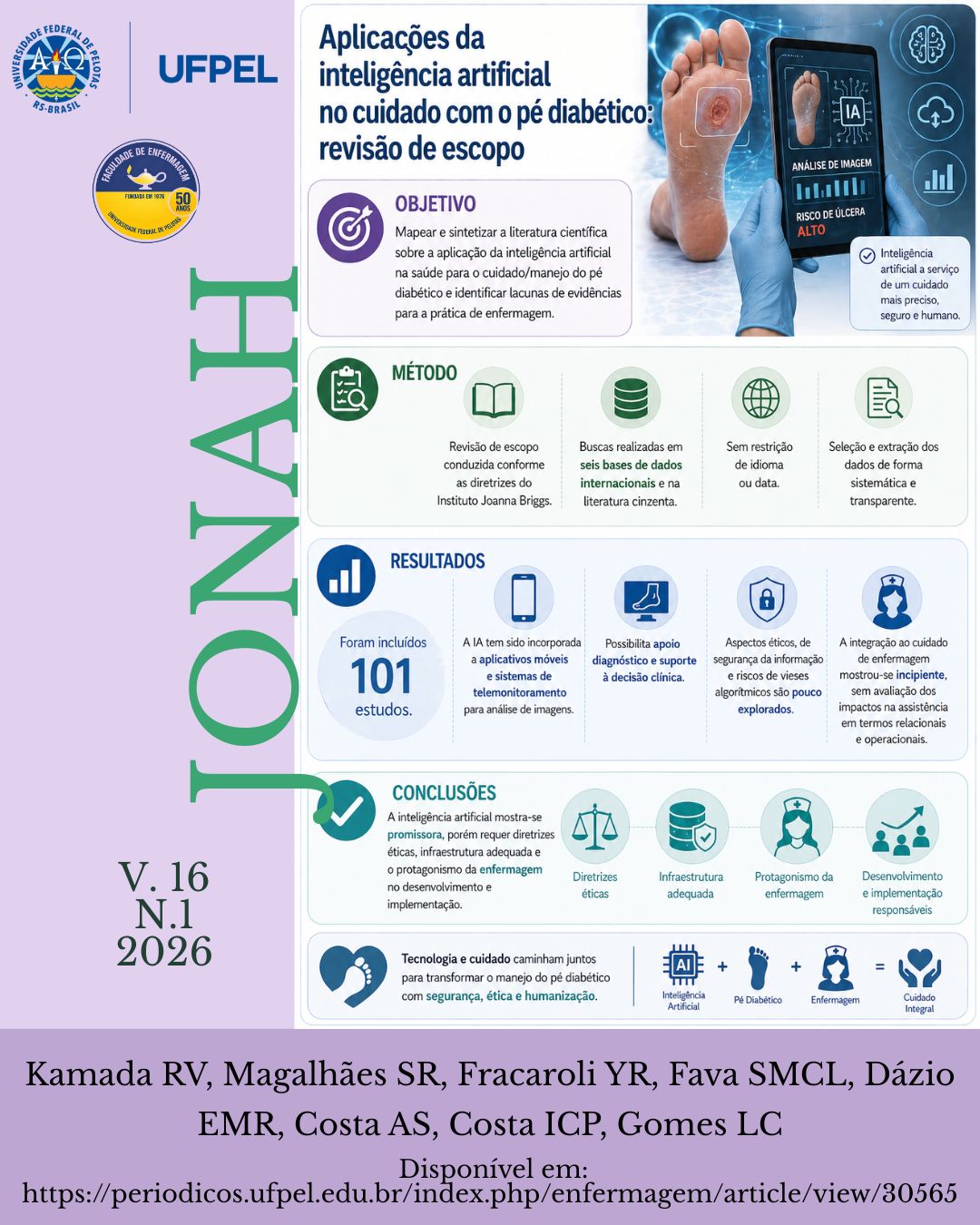
Objetivo: mapear e sintetizar a literatura científica sobre a aplicação da inteligência artificial na saúde para o cuidado/manejo do pé diabético e identificar lacunas de evidências para a prática de enfermagem. Método: revisão de escopo conduzida conforme as diretrizes do Instituto Joanna Briggs. As buscas foram realizadas em seis bases de dados internacionais e na literatura cinzenta, sem restrição de idioma ou data. Resultados: foram incluídos 101 estudos. A inteligência artificial tem sido incorporada à aplicativos móveis e sistemas de telemonitoramento para análise de imagens, possibilitando apoio diagnóstico e suporte à decisão clínica. Apesar dos avanços, aspectos éticos, de segurança da informação e riscos de vieses algorítmicos são pouco explorados. A integração ao cuidado de enfermagem mostrou-se incipiente, sem avaliação dos impactos na assistência em termos relacionais e operacionais. Conclusões: a inteligência artificial mostra-se promissora, porém requer diretrizes éticas, infraestrutura adequada e o protagonismo da enfermagem no desenvolvimento e implementação.
Downloads
Referências
Bus SA, Lavery LA, Monteiro-Soares M, Rasmussen A, Raspovic A, Sacco ICN, et al. Guidelines on the prevention of foot ulcers in persons with diabetes (IWGDF 2019 update). Diabetes Metab Res Rev. 2020;36(suppl 1):e3269. DOI: https://doi.org/10.1002/dmrr.3651
Zhang H, Huang C, Bai J, Wang J. Effect of diabetic foot ulcers and other risk factors on the prevalence of lower extremity amputation: a meta-analysis. Int Wound J. 2023;20(8):3035–47. DOI: https://doi.org/10.1111/iwj.141793
Sacco ICN, Lucovéis MLS, Thuler SR, Parisi MCR. Diagnóstico e prevenção de úlceras no pé diabético. São Paulo: Diretriz Oficial da Sociedade Brasileira de Diabetes; 2022. DOI: https://doi.org/10.29327/5412848.2024-11
Duarte Júnior EG, Lopes CF, Gaio DRF, Mariúba JVO, Cerqueira LO, Manhanelli Filho MAB, et al. Diretrizes da Sociedade Brasileira de Angiologia e de Cirurgia Vascular sobre o pé diabético 2023. J Vasc Bras. 2024; 23:e20230087. DOI: https://doi.org/10.1590/1677-5449.202300871
Torres DR, Wermelinger ED, Ferreira AP. Aplicação da Inteligência Artificial na Atenção Primária à Saúde: revisão de escopo e avaliação crítica. Saúde debate. 2025;49(145): e10070. DOI: https://doi.org/10.1590/2358-2898202514510070P
Raposo DRA, Alves-Júnior JS, Silva DTO, Alves RA, Santos DCM, Alves TM, et al. Avanços na assistência de enfermagem: uma revisão de escopo sobre o uso da Inteligência Artificial na ciência do cuidar. Contrib. cienc. soc. 2024;17(7):e8854. DOI: https://doi.org/10.55905/revconv.17n.7-417
Gomes AM, Dantas LB, Sobreira MMS, Araújo JNM, Tinôco JDS. Artificial intelligence in supporting the implementation of the nursing process: A scoping review. Rev. gaúch. enferm. 2025;45:e20250077. Disponível em: Disponível em: https://seer.ufrgs.br/index.php/rgenf/article/view/151062
O’Connor S, Yan Y, Thilo FJS, Felzmann H, Dowding D, Lee JJ. Artificial intelligence in nursing and midwifery: A systematic review. J Clin Nurs. 2022;00:1–18. DOI: https://doi.org/10.1111/jocn.16478
Ardelean A, Balta DF, Neamtu C, Neamtu AA, Rosu M, Totolici B. Personalized and predictive strategies for diabetic foot ulcer prevention and management. Med Pharm Rep. 2024;97(4): 419-28. DOI: https://doi.org/10.15386/mpr-2818
Papazafiropoulou AK. Diabetes management in the era of artificial intelligence. Arch Med Sci Aterosclerose Dis. 2024;9:e122–e128. DOI: https://doi.org/10.5114/amsad/183420
Aromataris E, Lockwood C, Porritt K, Pilla B, Jordan Z, editors. JBI Manual for Evidence Synthesis. Adelaide: JBI;2024. Available from: https://synthesismanual.jbi.global
Tricco AC, Lillie E, Zarin W, O'Brien KK, Colquhoun H, Levac D, et al. PRISMA Extension for Scoping Reviews (PRISMA-ScR): checklist and explanation. Ann Intern Med. 2018;169(7):467–73. DOI: https://doi.org/10.7326/m18-0850
Ouzzani M, Hammady H, Fedorowicz Z, Elmagarmid A. Rayyan—a web and mobile app for systematic reviews. Syst Rev. 2016;5(1):210. DOI: https://doi.org/10.1186/s13643-016-0384-4
Peters MDJ, Marnie C, Tricco AC, Pollock D, Munn Z, Alexander L, et al. Updated methodological guidance for the conduct of scoping reviews. JBI Evid Implement. 2021; 19(1):3–10. DOI: https://doi.org/10.11124/jbies-20-00167
Pollock D, Peters MDJ, Khalil H, McInerney P, Alexander L, Tricco AC, et al. Recommendations for the extraction, analysis, and presentation of results in scoping reviews. JBI Evid Synth. 2023;21(3):520–32. DOI: https://doi.org/10.11124/jbies-22-00123
Hill A. Is artificial intelligence the key to better foot self-care in diabetes? The Diabetic Foot J. 2023;26(2):24–8. Available from: https://diabetesonthenet.com/wp-content/uploads/DFJ-26-2_24-28_Hill.pdf
Rippon MG, Fleming L, Chen T, Rogers AA, Ousey K. Artificial intelligence in wound care: diagnosis, assessment and treatment of hard-to-heal wounds: a narrative review. J Wound Care. 2024;33(4):229-42. DOI: https://doi.org/10.12968/jowc.2024.33.4.229
Apolinário PP, Zanchetta FC, Pittella CQP, Lima MHM. Avanços da tecnologia de inteligência artificial no cuidado de úlceras no pé diabético. Rev. Enferm. Atual In Derme. 2024;98(3):e024377. DOI: https://doi.org/10.31011/reaid-2024-v.98-n.3-art.2326
Mayya V, Tummala V, Reddy CU, Mishra P, Boddu R, Olivia D, et al. Applications of machine learning in diabetic foot ulcer diagnosis using multimodal images: a review. IJAM. 2023;53(3):1-10. DOI: https://www.iaeng.org/IJAM/issues_v53/issue_3/IJAM_53_3_10.pdf
Almufadi NF, Alhasson HF, Alharbi SS. E-DFu-Net: an efficient deep convolutional neural network models for diabetic foot ulcer classification. Biomol Biomed. 2025;25(2):445-60. DOI: https://doi.org/10.17305/bb.2024.11117
Sumithra MG, Venkatesan C. SwinDFU-Net: Deep learning transformer network for infection identification in diabetic foot ulcer. Technol. health care. 2025; 33(1):601-18. DOI: https://doi.org/10.3233/THC-241444
Wu L, Huang R, He X, Tang L, Ma X. Advances in machine learning-aided thermal imaging for early detection of diabetic foot ulcers: a review. Biosensors. 2024;14(12):614. DOI: https://doi.org/10.3390/bios14120614
Wang C, Yu Z, Long Z, Zhao H, Wang Z. A few-shot diabetes foot ulcer image classification method based on deep ResNet and transfer learning. Sci Rep. 2024;14:29877. DOI: https://doi.org/10.1038/s41598-024-80691-w
Sidhu AS, Harbuzova V. Emerging technologies for the management of diabetic foot ulceration: a review. Front Clin Diabetes Healthc. 2024;12(5):1440209. DOI: https://doi.org/10.3389/fcdhc.2024.1440209
Almufadi N, Alhasson HF. Classification of diabetic foot ulcers from images using machine learning approach. Diagnostics (Basel). 2024;14(16):1807. DOI: https://doi.org/10.3390/diagnostics14161807
Biswas S, Mostafiz R, Uddin MS, Paul BK. XAI-FusionNet: diabetic foot ulcer detection based on multiscale feature fusion with explainable artificial intelligence. Heliyon. 2024;10:e31228. DOI: https://doi.org/10.1016/j.heliyon.2024.e31228
Wang Z, Tan X, Xue Y, Xiao C, Yue K, Lin K, et al. Smart diabetic foot ulcer scoring system. Sci Rep. 2024;14:11588. DOI: https://doi.org/10.1038/s41598-024-62076-1
Fadhel MA, Alzubaidi L, Gu Y, Santamaría J, Duan Y. Real-time diabetic foot ulcer classification based on deep learning & parallel hardware computational tools. Multimed Tools Appl. 2024;83:70369–94. DOI: https://doi.org/10.1007/s11042-024-18304-x
Oei CW, Chan YM, Zhang X, Leo KH, Yong E, Chong RC, et al. Risk prediction of diabetic foot amputation using machine learning and explainable artificial intelligence. J Diabetes Sci Technol. 2024;19(4):1008-22. DOI: https://doi.org/10.1177/19322968241228606
Demirkol D, Erol ÇS, Tannier X, Özcan T, Aktaş Ş. Prediction of amputation risk of patients with diabetic foot using classification algorithms: A clinical study from a tertiary center. Int Wound J. 2024;21(1):e14556. DOI: https://doi.org/10.1111/iwj.14556
Wu C, Xu C, Ou S, Wu X, Guo J, Qi Y, et al. A novel approach for diabetic foot diagnosis: Deep learning-based detection of lower extremity arterial stenosis. Diabetes Res Clin Pract. 2024;207:111032. DOI: https://doi.org/10.1016/j.diabres.2023.111032
Sun Y, Ge L, Ang YG, Lo ZJ, Liew H, Tan DM, et al. Cost-effectiveness and clinical outcomes of artificial intelligence-enhanced screening for diabetic foot ulcers: A simulation study. Ann Acad Med Singap. 2024;53(10):638-640. DOI: https://doi.org/10.47102/annals-acadmedsg.2024220
Dey AK, Kumari N, Motghare VM, Bapuji AT, Sai J, Thakur AK, et al. IDF23-0385 Technology advancement in the care of diabetic foot ulcers - the future perspective. Diabetes Res Clin Pract. 2024;209(1):111328. DOI: https://doi.org/10.1016/j.diabres.2024.111328
Sharma N, Mirza S, Rastogi A, Singh S, Mahapatra PK. Region-wise severity analysis of diabetic plantar foot thermograms. Biomed Tech (Berl). 2023;68(6):607-15. DOI: https://doi.org/10.1515/bmt-2022-0376
Cassidy B, Hoon YM, Pappachan JM, Ahmad N, Haycocks S, O'Shea C, et al. Artificial intelligence for automated detection of diabetic foot ulcers: A real-world proof-of-concept clinical evaluation. Diabetes Res Clin Pract. 2023;205:110951. DOI: https://doi.org/10.1016/j.diabres.2023.110951
Cao Z, Zeng Z, Xie J, Zhai H, Yin Y, Ma Y, et al. Diabetic plantar foot segmentation in active thermography using a two-stage adaptive gamma transform and a deep neural network. Sensors (Basel). 2023;23(20):8511. DOI: https://doi.org/10.3390/s23208511
Alqahtani A, Alsubai S, Rahamathulla MP, Gumaei A, Sha M, Zhang YD, et al. Empowering foot health: harnessing the adaptive weighted sub-gradient convolutional neural network for diabetic foot ulcer classification. Diagnostics (Basel). 2023;13(17):2831. DOI: https://doi.org/10.3390/diagnostics13172831
Sharma N, Mirza S, Rastogi A, Mahapatra PK. Utilizing mask R-CNN for automated evaluation of diabetic foot ulcer healing trajectories: a novel approach. IIETA. 2023;40(4):1601-10. DOI: https://doi.org/10.18280/ts.400428
Mousa KM, Mousa FA, Mohamed HS, Elsawy MM. Prediction of foot ulcers using artificial intelligence for diabetic patients at Cairo University Hospital, Egypt. SAGE Open Nurs. 2023;9:23779608231185873. DOI: https://doi.org/10.1177/23779608231185873
Gosak L, Svensek A, Lorber M, Stiglic G. Artificial intelligence based prediction of diabetic foot risk in patients with diabetes: a literature review. Appl. Sci. 2023;13(5):2823. DOI: https://doi.org/10.3390/app13052823
Poradzka AA, Czupryniak L. The use of the artificial neural network for three-month prognosis in diabetic foot syndrome. J Diabetes Complications. 2023;37(2):108392. DOI: https://doi.org/10.1016/j.jdiacomp.2022.108392
Pappachan JM, Cassidy B, Fernandez CJ, Chandrabalan V, Yap MH. The role of artificial intelligence technology in the care of diabetic foot ulcers: the past, the present, and the future. World J Diabetes. 2022;13(12):1131-9. DOI: https://doi.org/10.4239/wjd.v13.i12.1131
Huang HN, Zhang T, Yang CT, Sheen YJ, Chen HM, et al. Image segmentation using transfer learning and Fast R-CNN for diabetic foot wound treatments. Front Public Health. 2022; 10:969846. DOI: https://doi.org/10.3389/fpubh.2022.969846
Chan KS, Chan YM, Tan AHM, Liang S, Cho YT, Hong Q, et al. Clinical validation of an artificial intelligence-enabled wound imaging mobile application in diabetic foot ulcers. Int Wound J. 2022;19(1):114-24. DOI: https://doi.org/10.1111/iwj.13603
Munadi K, Saddami K, Oktiana M, Roslidar R, Muchtar K, Melinda M, et al. A deep learning method for early detection of diabetic foot using decision fusion and thermal images. Appl. Sci. 2022;12(15):7524. DOI: https://doi.org/10.3390/app12157524
Ahsan M, Naz S, Ahmad R, Ehsan H, Sikandar A. A deep learning approach for diabetic foot ulcer classification and recognition. Information. 2023;14(1):36. DOI: https://doi.org/10.3390/info14010036
Cassidy B, Reeves ND, Pappachan JM, Gillespie D, O'Shea C, Rajbhandari S, et al. The DFUC 2020 Dataset: analysis towards diabetic foot ulcer detection. touchREV Endocrinol. 2021;17(1):5-11. DOI: https://doi.org/10.17925/EE.2021.17.1.5
Filipe V, Teixeira P, Teixeira AA clustering approach for prediction of diabetic foot using thermal images. ICCSA. 2020; 12251:620-31. DOI: https://doi.org/ 10.1007/978-3-030-58808-3_45
Cruz-Vega I, Hernandez-Contreras D, Peregrina-Barreto H, Rangel-Magdaleno JJ, Ramirez-Cortes JM. Deep Learning classification for diabetic foot thermograms. Sensors (Basel). 2020;20(6):1762. DOI: https://doi.org/10.3390/s20061762
Guan H, Wang Y, Niu P, Zhang Y, Zhang Y, Miao R, et al. The role of machine learning in advancing diabetic foot: a review. Front Endocrinol (Lausanne). 2024;15:1245658. DOI: https://doi.org/10.3389/fendo.2024.1325434
Goyal M, Reeves ND, Davison AK, Rajbhandari S, Spragg J, Yap MH. Dfunet: convolutional neural networks for diabetic foot ulcer classification. IEEE Trans. Emerg. Top. Comput. Intell. 2020;4(5):728-39. DOI: https://doi.org/10.1109/TETCI.2018.2866254
Santos E, Santos F, Dallyson J, Aires K, Tavares JMRS, Veras R. Diabetic foot ulcers classification using a fine-tuned CNNs ensemble. IEEE Xplore. 2022;35:282-87, DOI: https://doi.org/10.1109/CBMS55023.2022.00056
Galdran A, Carneiro G, Ballester MAG. Convolutional Nets versus Vision Transformers for diabetic foot ulcer classification. DFUC. 2021;13183:21-9. DOI: https://doi.org/10.1007/978-3-030-94907-5_2
Amin J, Sharif M, Anjum MA, Khan HU, Malik MSA, Kadry S. An integrated design for classification and localization of diabetic foot ulcer based on CNN and YOLOV2-DFU models. IEEE Access. 2020;8:228586-97. DOI: https://doi.org/10.1109/ACCESS.2020.3045732
Reyes-Luévano J, Guerrero-Viramontes JA, Romo-AndradeJR, Funes-Gallanzi M. DFU_VIRnet: a novel visible-infrared CNN to improve diabetic foot ulcer classification and early detection of ulcer risk zones. Biomed Signal Process Control. 2023; 86:105341. DOI: https://doi.org/10.1016/j.bspc.2023.105341
Biswas S, Mostafiz R, Paul BK, Uddin KMM, Hadi A, Khamon F. DFU_XAI: A deep learning-based approach to diabetic foot ulcer detection using feature explainability. Biomedical Materials & Devices. 2024;2:1225–45. DOI: https://doi.org/10.1007/s44174-024-00165-5
Tulloch J, Zamani R, Akrami M. Machine learning in the prevention, diagnosis and management of diabetic foot ulcers: a systematic review. IEEE Access. 2020;8:198977-199000. DOI: https://doi.org/10.1109/ACCESS.2020.3035327
Chemello G, Salvatori B, Morettini M, Tura A. Artificial intelligence methodologies applied to technologies for screening, diagnosis and care of the diabetic foot: a narrative review. Biosensors. 2022;12(11):985. DOI: https://doi.org/10.3390/bios121109857
Tehsin S, Kausar S, Jameel A. Diabetic wounds and artificial intelligence: A mini-review. World J Clin Cases. 2023;11(1):84-91. DOI: https://doi.org/10.12998/wjcc.v11.i1.84
Howard T, Ahluwalia R, Papanas N. The advent of artificial intelligence in diabetic foot medicine: a new horizon, a new order, or a false dawn? Int J Low Extrem Wounds. 2023;22(4):635-40. DOI: https://doi.org/10.1177/15347346211041866
Das SK, Roy P, Singh P, Diwakar M, Singh V, Maurya A, et al. Diabetic foot ulcer identification: A Review. Diagnostics (Basel). 2023;13(12):1998. DOI: https://doi.org/10.3390/diagnostics13121998
Dębiec-Bąk A, Skrzek A, Ptak A, Majerski K, Uiberlayová I, Stefańska M, et al. Advantages of thermovision imaging for PPPM approach to diabetic foot. APPPM. 2023;17:233-42. DOI: https://doi.org/10.1007/978-3-031-34884-6_13
Toofanee MAS, Dowlut S, Hamroun M, Tamine K, Petit V, Duong AK. DFU-SIAM a novel diabetic foot ulcer classification with deep learning. IEEE Access. 2023;11:98315-32. DOI: https://doi.org/10.1109/ACCESS.2023.3312531
Srass H, Ead JK, Armstrong DG. Adherence and the diabetic foot: high tech meets high touch? Sensors (Basel). 2023;23(15):6898. DOI: https://doi.org/10.3390/s23156898
Prakash RV, Kumar KS. Development of automatic segmentation techniques using convolutional neural networks to differentiate diabetic foot ulcers. IJACSA. 2022;13(11):521-26. DOI: https://doi.org/10.14569/IJACSA.2022.0131160
Nanda R, Nath A, Patel S, Mohapatra E. Machine learning algorithm to evaluate risk factors of diabetic foot ulcers and its severity. Med Biol Eng Comput. 2022;60(8):2349-57. DOI: https://doi.org/10.1007/s11517-022-02617-w
Troitskaya NI, Shapovalov KG, Mudrov VA. Possibilities of multilayer perceptron in complexing risk factors of diabetic foot syndrome. Bull Exp Biol Med. 2022;173(4):415-18. DOI: https://doi.org/10.1007/s10517-022-05559-3
Bouallal D, Douzi H, Harba R. Diabetic foot thermal image segmentation using Double Encoder-ResUnet (DE-ResUnet). J Med Eng Technol. 2022;46(5):378-92. DOI: https://doi.org/10.1080/03091902.2022.2077997
Khandakar A, Chowdhury MEH, Reaz MBI, Ali SHM, Kiranyaz S, Rahman T, et al. A novel machine learning approach for severity classification of diabetic foot complications using thermogram images. Sensors (Basel). 2022;22(11):4249. DOI: https://doi.org/10.3390/s22114249
Haque F, Reaz MBI, Chowdhury MEH, Ezeddin M, Kiranyaz S, et al. Machine learning-based diabetic neuropathy and previous foot ulceration patients detection using electromyography and ground reaction forces during gait. Sensors (Basel). 2022;22(9):3507. DOI: https://doi.org/10.3390/s22093507
Khandakar A, Chowdhury MEH, Reaz MBI, Ali SHM, Abbas TO, Alam T, et al. Thermal change index-based diabetic foot thermogram image classification using machine learning techniques. Sensors (Basel). 2022;22(5):1793. DOI: https://doi.org/10.3390/s22051793
Costa T, Coelho L, Silva MF. Automatic segmentation of monofilament testing sites in plantar images for diabetic foot management. Bioengineering (Basel). 2022;9(3):86. DOI: https://doi.org/10.3390/bioengineering9030086
Wang S, Wang J, Zhu MX, Tan Q. Machine learning for the prediction of minor amputation in University of Texas grade 3 diabetic foot ulcers. PLoS One. 2022;17(12):e0278445. DOI: https://doi.org/10.1371/journal.pone.0278445
Muralidhara S, Lucieri A, Dengel A, Ahmed S. Holistic multi-class classification & grading of diabetic foot ulcerations from plantar thermal images using deep learning. Health Inf Sci Syst. 2022;10(1):21. DOI: https://doi.org/10.1007/s13755-022-00194-8
Xie P, Li Y, Deng B, Du C, Rui S, Deng W, et al. An explainable machine learning model for predicting in-hospital amputation rate of patients with diabetic foot ulcer. Int Wound J. 2022;19(4):910-8. DOI: https://doi.org/10.1111/iwj.13691
Zhang J, Qiu Y, Peng L, Zhou Q, Wang Z, Qi M. A comprehensive review of methods based on deep learning for diabetes-related foot ulcers. Front Endocrinol (Lausanne). 2022;13:945020. DOI: https://doi.org/10.3389/fendo.2022.945020
Al-Garaawi N, Ebsim R, Alharan AFH, Yap MH. Diabetic foot ulcer classification using mapped binary patterns and convolutional neural networks. Comput Biol Med. 2022;140:105055. DOI: https://doi.org/10.1016/j.compbiomed.2021.105055
Yogapriya J, Chandran V, Sumithra MG, Elakkiya B, Ebenezer AS, Dhas CSG. Automated detection of infection in diabetic foot ulcer images using convolutional neural network. J Healthc Eng. 2022;2022:2349849. DOI: https://doi.org/10.1155/2022/2349849
Kaselimi M, Protopapadakis E, Doulamis A, Doulamis N. A review of noninvasive sensors and artificial intelligence models for diabetic foot monitoring. Front. Physiol. 2022;13: 924546. DOI: https://doi.org/10.3389/fphys.2022.924546
Hernandez-Guedes A, Santana-Perez I, Arteaga-Marrero N, Fabelo H, Callico GM, Ruiz-Alzola J. Performance evaluation of deep learning models for image classification over small datasets: diabetic foot case study. IEEE Access. 2022;10:124373-86. DOI: https://doi.org/10.1109/ACCESS.2022.3225107
Anggreni NKIS, Kristianto H, Handayani D, Yueniwati Y, Irawan PLT, Rosandi R, et al. Artificial intelligence for diabetic foot screening based on digital image analysis: A systematic review. J Diabetes Sci Technol. 2025;17:19322968251317521. DOI: https://doi.org/10.1177/19322968251317521
Yap MH, Hachiuma R, Alavi A, Brüngel R, Cassidy B, Goyal M, et al. Deep learning in diabetic foot ulcers detection: A comprehensive evaluation. Comput Biol Med. 2021;135:104596. DOI: https://doi.org/10.1016/j.compbiomed.2021.104596
Schäfer Z, Mathisen A, Svendsen K, Engberg S, Rolighed Thomsen T, Kirketerp-Møller K. Toward machine-learning-based decision support in diabetes care: A risk stratification study on diabetic foot ulcer and amputation. Front Med (Lausanne). 2021;7:601602. DOI: https://doi.org/10.3389/fmed.2020.601602
Xu Y, Han K, Zhou Y, Wu J, Xie X, Xiang W. Classification of diabetic foot ulcers using class knowledge banks. Front Bioeng Biotechnol. 2022;9:811028. DOI: https://doi.org/10.3389/fbioe.2021.811028
Zhao N, Zhou Q, Hu J, Huang W, Xu J, Qi M, et al. Construction and verification of an intelligent measurement model for diabetic foot ulcer. J. Central South Univ. (Medical Sci). 2021;46(10):1138-46. DOI: https://doi.org/10.11817/j.issn.1672-7347.2021.200938
Lian Z, Wang H, Chen M, Li J. An improved plantar regional division algorithm for aided diagnosis of early diabetic foot. IJPRAI. 2020;34(14):20570062. DOI: https://doi.org/10.1142/S0218001420570062
Kim RB, Gryak J, Mishra A, Cui C, Soroushmehr SMR, Najarian K, et al. Utilization of smartphone and tablet camera photographs to predict healing of diabetes-related foot ulcers. Comput Biol Med. 2020;126:104042. DOI: https://doi.org/10.1016/j.compbiomed.2020.104042
Sequeira, MT. Aplicações de redes neurais convolucionais para a classificação de úlceras de pé diabético. [dissertação]. Porto (PT): Instituto Superior de Engenharia do Porto;2024. Disponível em: https://recipp.ipp.pt/bitstream/10400.22/26725/1/Tese_5624_v2.pdf
Goyal M, Reeves ND, Rajbhandari S, Ahmad N, Wang C, Yap MH. Recognition of ischemia and infection in diabetic foot ulcers: dataset and techniques. Comput. Biol. Med. 2020;117:103616. DOI: https://doi.org/10.1016/j.compbiomed.2020.103616
Thotad PN, Bharamagoudar GR, Anami BS. Diabetic foot ulcer detection using deep learning approaches. Sens Intern. 2023;4:100210. DOI: https://doi.org/10.1016/j.sintl.2022.100210
Chan KS, Lo ZJ. Wound assessment, imaging and monitoring systems in diabetic foot ulcers: A systematic review. Int Wound J. 2020;17(6):1909-23. DOI: https://doi.org/10.1111/iwj.13481
Cui C, Thurnhofer-Hemsi K, Soroushmehr R, Mishra A, Gryak J, Dominguez E, et al. Diabetic wound segmentation using Convolutional Neural Networks. Annu Int Conf IEEE Eng Med Biol Soc. 2019;2019:1002-05. DOI: https://doi.org/10.1109/EMBC.2019.8856665
Goyal M, Reeves ND, Rajbhandari S, Yap MH. Robust methods for real-time diabetic foot ulcer detection and localization on mobile devices. IEEE J Biomed Health Inform. 2019;23(4):1730-41. DOI: https://doi.org/10.1109/JBHI.2018.2868656
Cruz-Vega I, Peregrina-Barreto H, Rangel-Magdaleno JJ, Ramirez-Cortes JM. A comparison of intelligent classifiers of thermal patterns in diabetic foot. IEEE Xplore. 2019;12:1-6. DOI: https://doi.org/10.1109/I2MTC.2019.8827044
Wang L, Pedersen PC, Agu E, Strong DM, Tulu B. Area determination of diabetic foot ulcer images using a cascaded two-stage SVM-based classification. IEEE Trans Biomed Eng. 2017;64(9):2098-109. DOI: https://doi.org/10.1109/TBME.2016.2632522
Das SK, Roy P, Mishra AK. DFU_SPNet: a stacked parallel convolution layers based CNN to improve diabetic foot ulcer classification. ICT Express. 2022;8(2):271-5. DOI: https://doi.org/10.1016/j.icte.2021.08.022
Liu C, van Netten JJ, van Baal JG, Bus SA, van der Heijden F. Automatic detection of diabetic foot complications with infrared thermography by asymmetric analysis. J Biomed Opt. 2015;20(2):26003. DOI: https://doi.org/10.1117/1.JBO.20.2.026003
Vardasca R, Vaz L, Magalhães C, Seixas A, Mendes J. Towards the diabetic foot ulcers classification with infrared thermal images. QIRT. 2018;14:293-6. DOI: https://doi.org/10.21611/qirt.2018.008
Kairys A, Pauliukiene R, Raudonis V, Ceponis J. Towards home-based diabetic foot ulcer monitoring: A systematic review. Sensors. 2023;23:3618. DOI: https://doi.org/10.3390/s23073618
Basiri R, Manji K, LeLievre PM, Toole J, Kim F, Khan SS, et al. Protocol for metadata and image collection at diabetic foot ulcer clinics: enabling research in wound analytics and deep learning. Biomed Eng Online. 2024;23(1):12. DOI: https://doi.org/10.1186/s12938-024-01210-6
Huda MN, Musdholifah A, Frisky AZK. Optimization of plantar foot thermogram for diabetic foot ulceration early detection: An image enhancement approach. STC Journal. 2025;5(2):49-66. DOI: https://doi.org/10.59190/stc.v5i2.273
Goyal M, Yap MH, Reeves ND, Rajbhandari S, Spragg J. Fully convolutional networks for diabetic foot ulcer segmentation. IEEE Xplore. 2017;2017:618-23. DOI: https://doi.org/10.1109/SMC.2017.8122675
Alzubaidi L, Fadhel MA, Oleiwi SR, Al-Shamma O, Zhang J. DFU_QUTNet: diabetic foot ulcer classification using novel deep convolutional neural network. Multimed Tools Appl. 2020;79:15655–77. DOI: https://doi.org/10.1007/s11042-019-07820-w
Eid MM, Yousef RN, Mohamed MA. A proposed automated system to classify diabetic foot from thermography. IJSER. 2018;9(12):371-81. DOI: https://www.researchgate.net/publication/342164315_A_proposed_Automated_System_to_Classify_Diabetic_Foot_from_Thermography
Sarmun R, Chowdhury MEH, Murugappan M, Aqel A, Ezzuddin M, Rahman SM, et al. Diabetic foot ulcer detection: combining deep learning models for improved localization. Cognit Comput. 2024;16:1413–31. DOI: https://doi.org/10.1007/s12559-024-10267-3
Fraiwan L, AlKhodari M, Ninan J, Mustafa B, Saleh A, Ghazal M. Diabetic foot ulcer mobile detection system using smart phone thermal camera: a feasibility study. Biomed Eng Online. 2017;16(1):117. DOI: https://doi.org/10.1186/s12938-017-0408-x
Filipe V, Teixeira P, Teixeira A. Automatic classification of foot thermograms using machine learning techniques. Algorithms. 2022;15(7):236-51. DOI: https://doi.org/10.3390/a15070236
Cajacuri LAV. Early diagnostic of diabetic foot using thermal images [Thesis]. Orléans (FR): Université d'Orléans;2013. DOI: https://theses.hal.science/tel-01022921v1
Liu C, van der Heijden F, Klein ME, van Baal JG, Bus SA, van Netten JJ. Infrared dermal thermography on diabetic feet soles to predict ulcerations: a case study. SPIE BiOS. 2013;8572. DOI: https://doi.org/10.1117/12.2001807
Frykberg RG, Gordon IL, Reyzelman AM, Cazzell SM, Fitzgerald RH, Rothenberg GM, et al. Feasibility and efficacy of a smart mat technology to predict development of diabetic plantar ulcers. Diabetes Care. 2017;40(7):973-80. DOI: https://doi.org/10.2337/dc16-2294
Khandakar A, Chowdhury MEH, Ibne Reaz MB, Md Ali SH, Hasan MA, Kiranyaz S, et al. A machine learning model for early detection of diabetic foot using thermogram images. Comput Biol Med. 2021;137:104838. DOI: https://doi.org/10.1016/j.compbiomed.2021.104838
Ahmad M, Tan M, Shalhoub J, Davies A. The use of artificial intelligence in three-dimensional imaging modalities and diabetic foot disease: A systematic review. JVS Vasc Insights. 2024;2:100057. DOI: https://doi.org/10.1016/j.jvsvi.2024.100057
Oliveira ALC, Carvalho AB, Dantas DO. Faster R-CNN approach for diabetic foot ulcer detection. VISAPP. 2021;4:677-84. DOI: https://doi.org/105220/0010255506770684
Gamage HVLC, Wijesinghe WOKIS, Perera I. Instance-based segmentation for boundary detection of neuropathic ulcers through Mask-RCNN. ICANN. 2019;11731:511-22. DOI: https://doi.org/10.1007/978-3-030-30493-5_49
Ferreira ACBH, Ferreira DD, Oliveira HC, Resende IC, Anjos A, Lopes MHBM. Competitive neural layer-based method to identify people with high risk for diabetic foot. Comput Biol Med. 2020;120:103744. DOI: https://doi.org/10.1016/j.compbiomed.2020.103744
Kaabouch N, Chen Y, Anderson J, Ames F, Paulson R. Asymmetry analysis based on genetic algorithms for the prediction of foot ulcers. SPIE. 2009;7243:724304. DOI: https://doi.org/10.1117/12.805975
Alkhalefah S, AlTuraiki I, Altwaijry N. Advancing diabetic foot ulcer care: AI and Generative AI approaches for classification, prediction, segmentation, and detection. Healthcare (Basel). 2025;13(6):648. DOI: https://doi.org/10.3390/healthcare13060648
Persson V, Wickman UL. Artificial intelligence as a tool for self-care in patients with diabetes. Healthcare (Basel). 2025;13(8):950. DOI: https://doi.org/10.3390/healthcare13080950
Mayya V, Kandala RNVPS, Gurupur V, King C, Vu GT, Wan THT. Need for an Artificial Intelligence-based Diabetes Care Platform. Health Serv Res Manag Epidemiol. 2024;11:23333928241275292. DOI: https://doi.org/10.1177/23333928241275292
Foppen RJG, Gioia, V, Gupta S, Johnson CL, Giantsidis J, Papademetris M. Methodology for safe and secure AI in diabetes. J Diabetes Sci Technol. 2024;19(3):620-7. DOI: https://doi.org/10.1177/19322968241304434
Rathore PS, Kumar A, Nandal A, Daca A, Sharma AK. A feature explainability-based deep learning technique for diabetic foot ulcer diagnosis. Sci Rep. 2025. DOI: https://doi.org/10.1038/s41598-025-90780-z
El Arab RA, Al Moosa OA, Abuadas FH, Somerville J. The role of AI in nursing education and practice: umbrella review. J Med Internet Res. 2025;27:e69881. DOI: https://doi.org/10.2196/69881
von Gerich H, Moen H, Block LJ, Chu HC, DeForest H, Hobensack M, et al. Artificial Intelligence -based technologies in nursing: A scoping literature review of the evidence. Int J Nurs Stud. 2022;127:e104156. DOI: https://doi.org/10.1016/j.ijnurstu.2021.104153
Pereira CLA, Coelho VAT, Nascimento ES, Bigatello CS. Integração da Inteligência Artificial na Enfermagem: avanços, desafios e perspectivas para a prática professional. Id on Line Rev Psic. 2025;19(78):324-36. DOI: https://doi.org/10.14295/idonline.v19i78.4283
Kabir MA, Samad S, Ahmed F, Naher S, Featherston J, Laird C, et al. Mobile apps for wound assessment and monitoring. J Med Syst. 2024;48(1):80. DOI: https://doi.org/10.1007/s10916-024-02091-x
American Nurses Association. The ethical use of artificial intelligence in nursing practice. Silver Spring: ANA. 2022. Available from: https://www.nursingworld.org/globalassets/practiceandpolicy/nursing-excellence/ana-position-statements/the-ethical-use-of-artificial-intelligence-in-nursing-practice_bod-approved-12_20_22.pdf
Vitorino LM, Yoshinari Júnior GH, Lopes-Júnior LC. Inteligência Artificial na Enfermagem: avanços no julgamento clínico e na tomada de decisão. Rev. bras. enferm. 2025;78(4):e780401. DOI: https://doi.org/10.1590/0034-7167.2025780401pt
Copyright (c) 2026 Universidade Federal de Pelotas

This work is licensed under a Creative Commons Attribution-NonCommercial 4.0 International License.
INSTRUÇÕES: Copiar o texto a seguir em arquivo DOC, preenchendo corretamente o título, imprimir, assinar (todos os autores) e submeter nos ARQUIVOS SUPLEMENTARES o arquivo escaneado em formato PDF, com tamanho máximo de 1MB.
DECLARAÇÃO DE RESPONSABILIDADE E AUTORIA E DE CESSÃO DE DIREITOS AUTORAIS
Submetemos à aprovação do Journal of Nursing and Health (JONAH) o manuscrito "TÍTULO (máximo 15 palavras)", e declaramos que o trabalho é inédito, original e está sendo enviado com exclusividade ao Journal.
Concordamos que em caso de aceitação do manuscrito, os direitos autorais a ele referente passarão a ser propriedade exclusiva do Journal of Nursing and Health (JONAH), sob licença Creative Commons 4.0 e com a divulgação do artigo em mídias sociais da Revista.
Informamos igualmente que todos os procedimentos éticos devidos foram observados, não infringindo nenhum copyright ou nenhum outro tipo de direito de propriedade de outras pessoas e todas as citações no texto são fatos verdadeiros ou baseados em pesquisa de exatidão científica.
Declaramos que cada autor (NOME DOS AUTORES DO MANUSCRITO EM ORDEM) do artigo contribuiu substancialmente para a concepção e planejamento do estudo, seu projeto, obtenção de dados ou análise e interpretação de dados; também contribuiu significativamente com a elaboração do esboço ou a revisão crítica importante do conteúdo intelectual deste manuscrito e aprovou a versão final do manuscrito.
Concordamos em ser responsável por todos os aspectos do trabalho, garantindo à exatidão ou à integridade de qualquer parte da obra.
E por fim, declaramos que FORAM OU NÃO FORAM UTILIZADOS recursos de inteligência artificial para a construção do texto. (CASO TENHA SIDO UTILIZADO ALGUM RECURSO DE IA, INFORMAR SE FOI PARA ESCRITA / MELHORAMENTO DO TEXTO, PRODUÇÃO, ANÁLISE OU GERAÇÃO DE DADOS).
Categoria do artigo: ______________________________
Data: ___/____/____
Nome completo do autor:________________________
Assinatura: ______________________________
Nome completo do autor:________________________
Assinatura: ______________________________
Nome completo do autor:________________________
Assinatura: ______________________________
Nome completo do autor:________________________
Assinatura: ______________________________
Nome completo do autor:________________________
Assinatura: ______________________________
Versão em inglês - English version
INSTRUCTIONS: Copy the following text into a DOC file, correctly filling in the title, printing, signing (all authors) and submitting the scanned file in PDF format to the SUPPLEMENTARY DOCUMENTS, with a maximum size of 1MB.
DECLARATION OF RESPONSIBILITY AND AUTHORSHIP AND COPYRIGHT ASSIGNMENT
We submit the manuscript "TITLE (maximum 15 words)" for approval by the Journal of Nursing and Health (JONAH) and declare that the work is unpublished, original and is being sent exclusively to the Journal. We agree that if the manuscript is accepted, the copyrights related to it will become the exclusive property of the Journal of Nursing and Health (JONAH), under a Creative Commons 4.0 license and with the dissemination of the article on the Journal's social media. We also inform that all due ethical procedures were observed, without infringing any copyright or any other type of property right of other people and all citations in the text are true facts or based on scientifically accurate research. We declare that each author (NAME OF MANUSCRIPT AUTHORS IN ORDER) of the article contributed substantially to the conception and planning of the study, its design, data acquisition or data analysis and interpretation; also contributed significantly to the preparation of the draft or the important critical review of the intellectual content of this manuscript and approved the final version of the manuscript. We agree to be responsible for all aspects of the work, ensuring the accuracy or integrity of any part of the work. And finally, we declare whether artificial intelligence resources WERE OR WERE NOT USED for the construction of the text. (IF ANY AI RESOURCE WAS USED, INFORM WHETHER IT WAS FOR WRITING/IMPROVING THE TEXT, PRODUCTION, ANALYSIS OR DATA GENERATION).
Article Category: ____________________________________________________
Date: ___/____/____
Author's Full Name:____________________________________________
Signature: ________________________________
Author's Full Name:_____________________________________________
Signature: ________________________________
Author's Full Name:_____________________________________________
Signature: ________________________________
Author's Full Name:_____________________________________________
Signature: ________________________________
Author's Full Name:_____________________________________________
Signature: ________________________________