
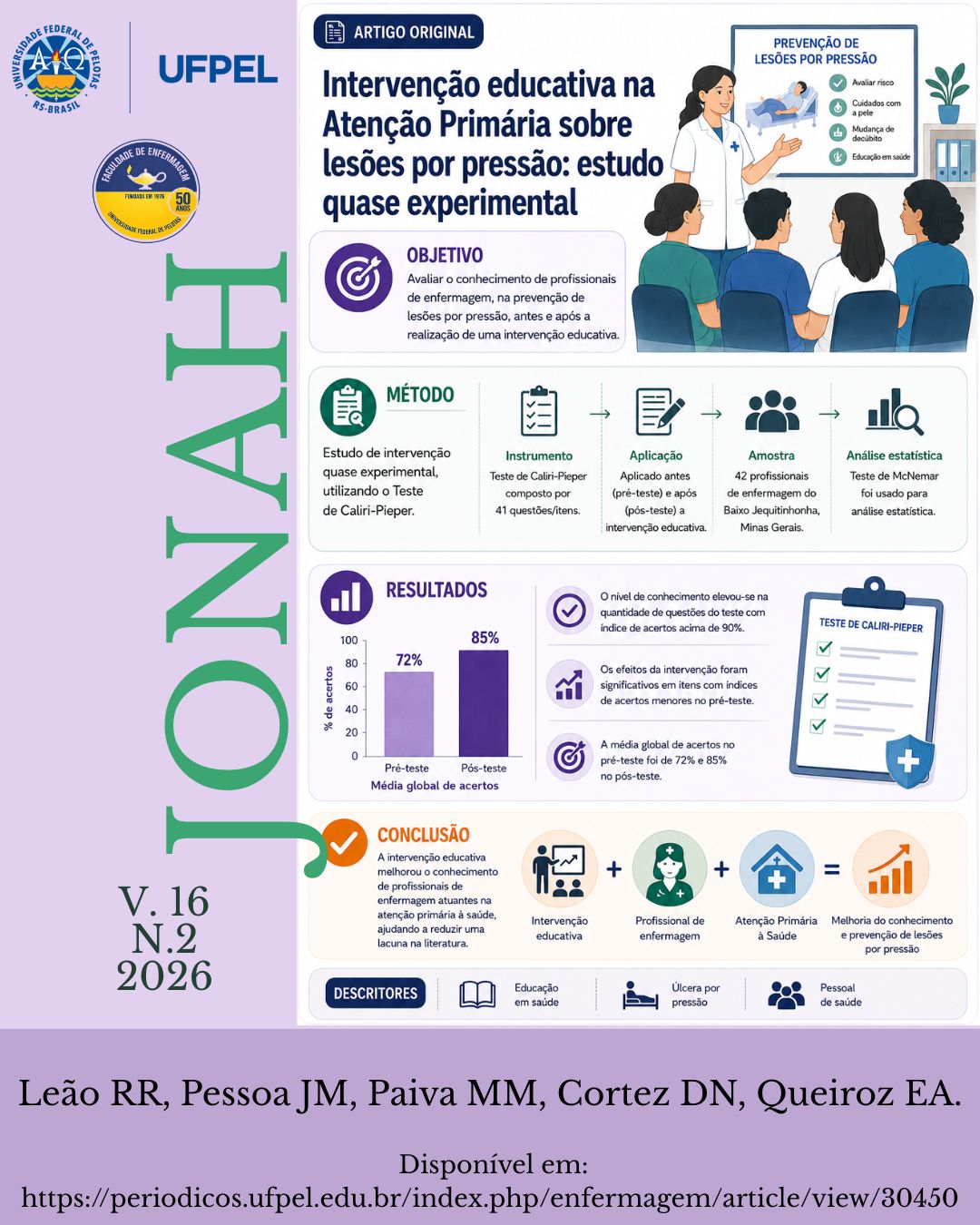
Intervenção educativa na Atenção Primária sobre lesões por pressão: estudo quase experimental
Resumo
Objetivo: Avaliar o conhecimento de profissionais de enfermagem, na prevenção de lesões por pressão, antes e após a realização de uma intervenção educativa. Método: Trata-se de estudo de intervenção quase experimental, utilizando o Teste de Caliri-Pieper, composto por 41 questões/itens, aplicado antes (pré-teste) e após (pós-teste) a realização da intervenção educativa. A amostra foi composta por 42 profissionais de enfermagem do Baixo Jequitinhonha, Minas Gerais. O teste de McNemar foi usado para análise estatística. Resultados: o nível de conhecimento elevou-se nas quantidade de questões do teste com índice de acertos acima de 90% de acertos. Os efeitos da intervenção foram significativos em itens com índices de acertos menores no pré-teste. A média global de acertos no pré-teste foi de 72% e 85% no pós-teste. Conclusão: A intervenção educativa melhorou o conhecimento de profissionais de enfermagem atuantes na atenção primária à saúde, ajudando a reduzir uma lacuna na literatura.
Downloads
Referências
National Pressure Injury Advisory Panel (NPIAP). Prevention and treatment of pressure ulcers/injuries: clinical practice guideline. Chicago: NPIAP; 2019. Available from: https://internationalguideline.com/2019
Alito A, Portaro S, Leonardi G, Ventimiglia C, Bonanno F, Fenga D, et al. Pressure ulcers: a longstanding problem. A 7-year neurorehabilitation unit experience of management, care, and clinical outcomes. Diagnostics (Basel). 2023;13(20):3213. DOI: https://doi.org/10.3390/diagnostics13203213
de Bengy AF, Lamartine J, Sigaudo-Roussel D, Fromy B. Newborn and elderly skin: two fragile skins at higher risk of pressure injury. Biological Reviews. 2022;97(3):874-95. DOI: https://doi.org/10.1111/brv.12827
Sugathapala RDUP, Latimer S, Balasuriya A, Chaboyer W, Thalib L, Gillespie BM. Prevalence and incidence of pressure injuries among older people living in nursing homes: A systematic review and meta-analysis. International Journal of Nursing Studies. 2023;148:104605. DOI: https://doi.org/10.1016/j.ijnurstu.2023.104605
Brauer M, Roth GA, Aravkin AY, Zheng P, Abate KA, Abate YH, et al. Risk Factors Collaborators. Global burden and strength of evidence for 88 risk factors in 204 countries and 811 subnational locations, 1990-2021: a systematic analysis for the Global Burden of Disease Study 2021. Lancet. 2024;403(10440):2162-2203. DOI: https://doi.org/10.1016/S0140-6736(24)00933-4
Vieira CPB, Araújo TME. Prevalence and factors associated with chronic wounds in older adults in primary care. Rev. Esc. Enferm. USP. 2018;52:e03415. DOI: https://doi.org/10.1590/S1980-220X2017051303415.
Galetto SGS, Nascimento ERP, Hermida PMV, Busanello J, Malfussi LBH, Lazzari DD. Medical device-related pressure injuries in critical patients: prevalence and associated factors. Rev. Esc. Enferm. USP. 2021;55:e20200397. DOI: https://doi.org/10.1590/1980-220X-REEUSP-2020-0397
Alshahrani B, Sim J, Middleton R. Nursing interventions for pressure injury prevention among critically ill patients: a systematic review. Journal of Clinical Nursing. 2021;30(15-16):2151-68. DOI: https://doi.org/10.1111/jocn.15709
Galetto SGS, Nascimento ERP, Hermida PMV, Busanello J, Malfussi LBH, Lazzari DD. Medical device-related pressure injury prevention in critically ill patients: nursing care. Rev. bras. enferm. 2021;74(2):e20200062. DOI: https://doi.org/10.1590/0034-7167-2020-0062
Lovegrove J, Fulbrook P, Miles S, Steele M. Effectiveness of interventions to prevent pressure injury in adults admitted to intensive care settings: a systematic review and meta-analysis of randomised controlled trials. Australian Critical Care. 2022;35(2):186-203. DOI: https://doi.org/10.1016/j.aucc.2021.04.007
Zhang YB, He L, Gou L, Pei JH, Nan RL, Chen HX, et al. Knowledge, attitude, and practice of nurses in intensive care unit on preventing medical device-related pressure injury: a cross-sectional study in western China. International Wound Journal. 2021;18(6):777-86. DOI: https://doi.org/10.1111/iwj.13581
Liang H, Hu H, Feng L, Wei H, Ying Y, Liu Y. The knowledge and attitude on the prevention of pressure ulcers in Chinese nurses: a cross-sectional study in 93 tertiary and secondary hospitals. International Wound Journal. 2024;21(4):e14593. DOI: https://doi.org/10.1111/iwj.14593
Delmore B, Ayello EA, Smart H, Sibbald RG. Assessing pressure injury knowledge using the Pieper-Zulkowski Pressure Ulcer Knowledge Test. Advances in Skin & Wound Care. 2018;31(9):406-12. DOI: https://doi.org/10.1097/01.ASW.0000540071.45158.29
Galvão NS, Serique MAB, Santos VLCG, Nogueira PC. Knowledge of the nursing team on pressure ulcer prevention. Rev. bras. enferm. 2017;70(2):294-300. DOI: https://doi.org/10.1590/0034-7167-2016-0063
Albuquerque AM, Mendonça AEO, de Souza MA, Torquato IMB, Gouveia BLA, Soares MJGO. Prevenção de lesão por pressão: efetividade de intervenção educativa no conhecimento de profissionais de enfermagem. Rev. Enferm. Atual In Derme. 2023;97(4):e023183. https://doi.org/10.31011/reaid-2023-v.97-n.4-art.1914
Sari SP, Everink IH, Amir Y, Lohrmann C, Halfens RJ, Moore Z, et al. Knowledge and attitude of community nurses on pressure injury prevention: a cross-sectional study in an Indonesian city. International Wound Journal. 2021;18(4):422-31. DOI: https://doi.org/10.1111/iwj.13527
Przybek-Mita J, Bazaliński D, Małek E, et al. Knowledge in the area of prevention and treatment of pressure injuries among nurses: report from the study. Healthcare (Basel). 2025;13(1):65. DOI: https://doi.org/10.3390/healthcare13010065
Rabeh SAN, Palfreyman S, Souza CBL, Bernardes RM, Caliri MHL. Cultural adaptation of the Pieper-Zulkowski Pressure Ulcer Knowledge Test for use in Brazil. Rev. bras. enferm. 2018;71(4):1977-84. DOI: https://doi.org/10.1590/0034-7167-2017-0029
Instituto Brasileiro de Geografia e Estatística (IBGE). Censo demográfico 2010. Rio de Janeiro: IBGE;2010. Disponível em: https://www.ibge.gov.br/estatisticas/sociais/saude/9662-censo-demografico-2010.html
John AM, Nayak UKR, Lobo G, Thaleppaddy M. Assessment of pressure injury knowledge using PZ-PUKT questionnaire among Indian nurses and the evaluation of impact of an educational intervention on the knowledge scores: a quasi-experimental study. Journal of Tissue Viability. 2024;33(2):215-9. DOI: https://doi.org/10.1016/j.jtv.2024.02.002
Araújo CAF, Pereira SRM, Paula VG, Oliveira JA, Andrade KBS, Oliveira NVD, et al. Evaluation of the knowledge of nursing professionals in the prevention of pressure ulcer in intensive care. Esc. Anna Nery Rev. Enferm. 2022;26:e20210200. DOI: https://doi.org/10.1590/2177-9465-EAN-2021-0200
Adriani PA, Paggiaro AO, Ferreira MC, Carvalho VF. Aplicação do Pressure Ulcer Knowledge Test em enfermeiros de um hospital de atenção secundária: estudo transversal. Rev. Enferm. Atual In Derme. 2019;87(25). DOI: https://doi.org/10.31011/reaid-2019-v.87-n.25-art.480
Fulbrook P, Lawrence P, Miles S. Australian nurses' knowledge of pressure injury prevention and management: a cross-sectional survey. Journal of Wound, Ostomy and Continence Nursing. 2019;46(2):106-12. DOI: https://doi.org/10.1097/WON.0000000000000508
Ebi WE, Hirko GF, Mijena DA. Nurses' knowledge of pressure ulcer prevention in public hospitals in Wollega: a cross-sectional study. BMC Nursing. 2019;18:20. DOI: https://doi.org/10.1186/s12912-019-0346-y
Soares CF, Heidemann ITSB. Health promotion and prevention of pressure injury: expectations of primary health care nurses. Texto & contexto enferm. 2018;27(2):e1630016. DOI: https://doi.org/10.1590/0104-070720180001630016
Vieira CPB, Oliveira EWF, Ribeiro MGC, Luz MHBA, Araújo OD. Ações preventivas em úlceras por pressão realizadas por enfermeiros na atenção básica. Rev. Pesqui. (Univ. Fed. Estado Rio J., Online). 2016;8(2):4447-59. DOI: https://doi.org/10.9789/2175-5361.2016.v8i2.4447-4459
Tristão FR, Girondi JBR, Hammerschmid KSA, Zamprogna KM, Soares CF, Evaristo SM, et al. Nursing care practices in primary health care: elderly people’s skin care management. Cogitare Enferm. (Online). 2020;25:e65223. DOI: https://doi.org/10.5380/ce.v25i0.65223
Meireles VC, Baldissera VDA. Quality of care for the elderly: pressure injury risk as a marking condition. Rev Rene (Online). 2019;20:e40122. Disponível em: https://www.redalyc.org/journal/3240/324058874013/
Copyright (c) 2026 Universidade Federal de Pelotas

This work is licensed under a Creative Commons Attribution-NonCommercial 4.0 International License.
INSTRUÇÕES: Copiar o texto a seguir em arquivo DOCX preenchendo corretamente o título, imprimir, assinar digitalmente, preferencialmente via GOV (todos os autores) e submeter nos ARQUIVOS SUPLEMENTARES o arquivo em formato PDF, com tamanho máximo de 1MB.
DECLARAÇÃO DE RESPONSABILIDADE, AUTORIA,
CONTRIBUIÇÕES E CESSÃO/AUTORIZAÇÃO DE DIREITOS AUTORAIS
Periódico: Journal of Nursing and Health (JONAH)
Título do manuscrito: ________________________________________________________________
Categoria do artigo: __________________________________________________________________
1. Originalidade, exclusividade e responsabilidade
Nós, autores identificados nesta declaração, submetemos o manuscrito acima ao Journal of Nursing and Health (JONAH) e declaramos que o trabalho é original, inédito e submetido com exclusividade a este periódico. Declaramos que o manuscrito não está publicado, no todo ou em parte, nem em avaliação simultânea por outro periódico, ressalvadas situações previamente informadas e aceitas pela equipe editorial.
Declaramos que o trabalho foi conduzido de acordo com os princípios éticos aplicáveis e que as autorizações éticas necessárias foram obtidas, quando pertinentes. As citações, os dados, as imagens, os instrumentos e os demais materiais de terceiros foram utilizados de forma adequada, com atribuição de autoria e obtenção das permissões necessárias quando exigidas.
Confirmamos que todos os autores listados atendem aos critérios de autoria adotados pelo periódico, participaram de modo significativo do trabalho, aprovaram a versão final do manuscrito e concordam com sua submissão ao JONAH. Todos assumimos responsabilidade pelo conteúdo e nos comprometemos a colaborar na apuração e correção de eventuais questões relacionadas à exatidão ou à integridade de qualquer parte do trabalho.
2. Contribuições individuais dos autores (taxonomia CRediT)
As contribuições de cada autor devem ser informadas individualmente, de acordo com a taxonomia CRediT. Um autor pode exercer mais de um papel, e um mesmo papel pode ser compartilhado por vários autores. Assinalar somente as funções efetivamente desempenhadas por cada pessoa. A descrição das contribuições não substitui os critérios de autoria do periódico.
- Conceituação (Conceptualization): Definição das ideias e objetivos da pesquisa.
- Curadoria de dados (Data curation): Organização, documentação, limpeza e manutenção dos dados.
- Análise formal (Formal analysis): Aplicação de métodos analíticos ou estatísticos.
- Obtenção de financiamento (Funding acquisition): Obtenção do apoio financeiro.
- Investigação (Investigation): Condução da pesquisa e coleta de dados.
- Metodologia (Methodology): Desenvolvimento ou desenho da metodologia.
- Administração do projeto (Project administration): Coordenação e gestão do projeto.
- Recursos (Resources): Disponibilização de materiais, instrumentos, participantes ou recursos.
- Software: Programação, desenvolvimento ou implementação de software e códigos.
- Supervisão (Supervision): Supervisão e liderança do planejamento ou da execução.
- Validação (Validation): Verificação da reprodutibilidade, consistência ou confirmação dos resultados.
- Visualização (Visualization): Preparação de figuras, tabelas, gráficos ou outras apresentações dos dados.
- Redação – versão original (Writing – original draft): Redação da primeira versão do manuscrito.
- Redação – revisão e edição (Writing – review & editing): Revisão crítica, comentários e edição do manuscrito.
Identificação dos autores e respectivos papéis CRediT (preencher uma linha por autor; acrescentar linhas, se necessário):
|
Nome completo do autor, na ordem do manuscrito |
ORCID e Currículo Lattes |
Contribuições CRediT desempenhadas |
|
|
|
|
|
|
|
|
|
|
|
|
|
|
|
|
|
|
|
|
|
|
|
|
|
|
|
|
|
|
|
|
3. Declaração de uso de inteligência artificial (IA)
Declaramos que (assinalar uma opção):
☐ NÃO foram utilizadas ferramentas de inteligência artificial generativa na elaboração do manuscrito.
☐ FORAM utilizadas ferramentas de inteligência artificial. Nesse caso, preencher as informações abaixo e descrever, de forma transparente, a ferramenta utilizada e a finalidade de seu uso.
|
Ferramenta e versão (se disponível) |
Etapa/finalidade do uso |
Como foi utilizada e verificada pelos autores |
|
|
|
|
|
|
|
|
|
|
|
|
A declaração deve especificar, conforme aplicável, se a IA foi utilizada para apoio à redação ou revisão linguística, tradução, concepção, análise, produção ou geração de dados, imagens, códigos ou outros materiais. Os autores são responsáveis por verificar as informações produzidas ou modificadas com auxílio dessas ferramentas e pela versão final do manuscrito. Ferramentas de IA não devem ser indicadas como autoras. A declaração deve observar as orientações aplicáveis do CNPq, da UFPel e do JONAH.
4. Direitos autorais e licença de publicação
Em caso de aceitação, autorizamos a publicação e a divulgação do manuscrito pelo Journal of Nursing and Health (JONAH), inclusive em suas mídias e canais institucionais, nos termos da licença Creative Commons Atribuição-Não Comercial 4.0 Internacional (CC BY-NC 4.0) adotada pelo periódico. Declaramos estar cientes de que a licença permite o compartilhamento e a adaptação da obra para fins não comerciais, desde que seja atribuída a autoria e observadas as condições da licença.
Declaramos que o manuscrito não viola direitos autorais, direitos de imagem, privacidade ou outros direitos de terceiros. Quando forem utilizados materiais de terceiros sujeitos a autorização, os autores são responsáveis por obter e conservar as permissões necessárias.
5. Tradução para publicação
Estamos cientes de que todos os artigos aceitos para publicação nos números regulares do JONAH a partir de 2027 deverão ser publicados, também, em língua inglesa, independentemente da data em que o manuscrito tenha sido submetido. Compreendemos que caso o manuscrito seja aceito para publicação em número regular de 2027, os autores serão responsáveis por providenciar e custear a tradução para o inglês.
6. Informações adicionais
Nº de registro da revisão sistemática ou de escopo (ex.: PROSPERO, OSF ou outro registro pertinente; informar “não se aplica” quando cabível: ______________________________________
Financiamento (informar agência e número do processo, ou declarar que não houve financiamento): _____________________________________________________________________
Conflitos de interesse (informar, ou declarar inexistência):________________________________________________________________________
Local e data: _______________________________________________________________________
As assinaturas de todos os autores devem ser digitais, realizadas por meio da plataforma GOV.BR ou de ferramenta equivalente que permita verificar a autenticidade da assinatura.
Ao assinar, cada autor confirma que leu e concorda com as declarações acima, com a descrição das contribuições CRediT e com a declaração de uso ou não uso de ferramentas de IA.
|
Nome completo: __________________________________________
|
Assinatura: |
|
Nome completo: _________________________________________ _ |
Assinatura: |
|
Nome completo: __________________________________________
|
Assinatura: |
|
Nome completo: __________________________________________
|
Assinatura: |
|
Nome completo: __________________________________________
|
Assinatura: |
|
Nome completo: __________________________________________
|
Assinatura: |
|
Nome completo: __________________________________________
|
Assinatura: |
|
Nome completo: __________________________________________
|
Assinatura: |