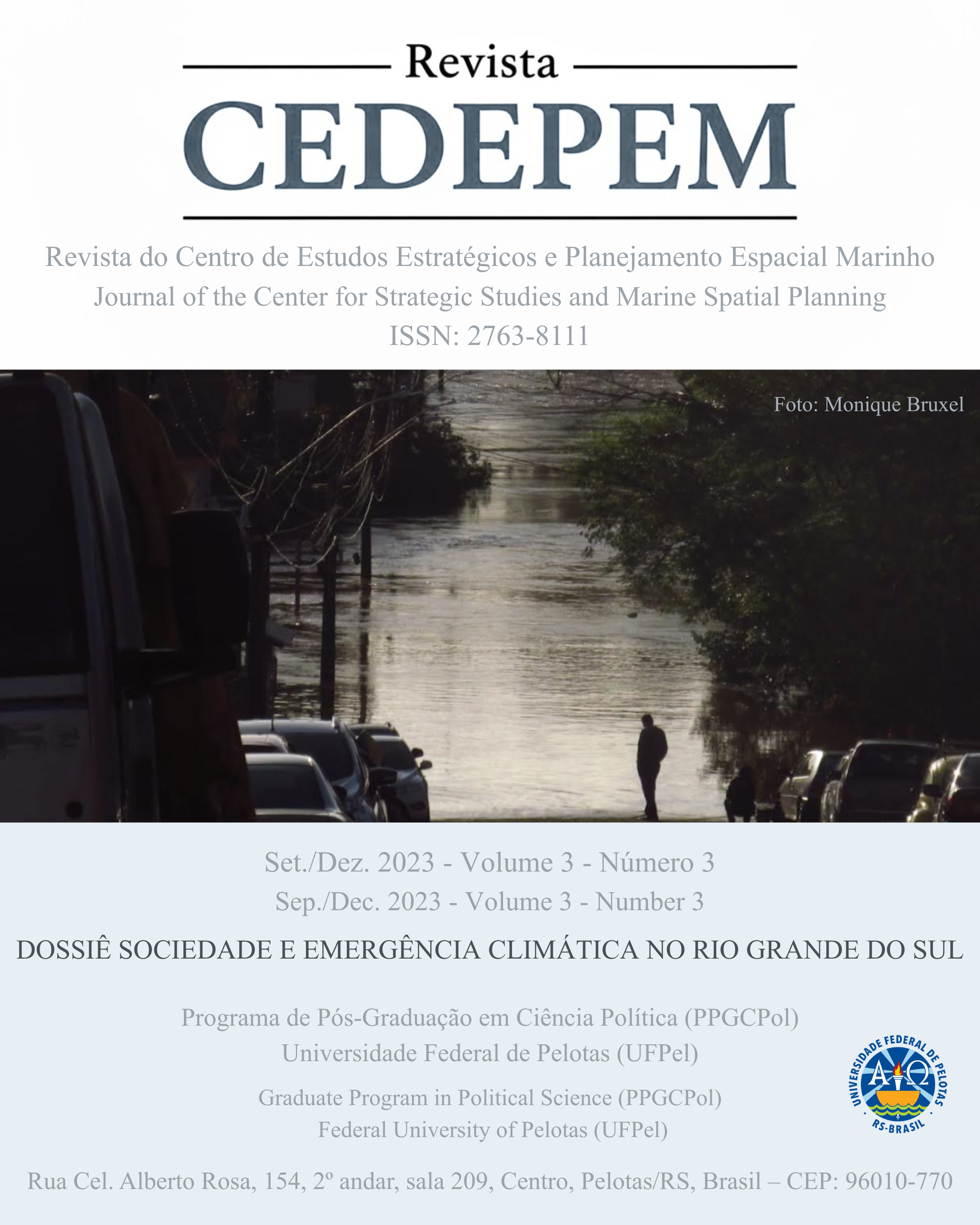
Global Climate Changes: A Report from the South of Rio Grande do Sul
Abstract
First Paragraph: I am a native of the State of Paraíba, having been born and raised within its borders. In that region, solar irradiation and heat constitute constant and, almost invariably, enduring elements. Regarding the State of Rio Grande do Sul, my prior knowledge was limited; indeed, my familiarity extended little beyond certain clichés and imagery associated with the gaúcho identity—such as chimarrão, specific idiomatic expressions, and, naturally, low temperatures. The climate, in its entirety, has proven to be more formidable than anticipated; manifesting through hailstorms or flooding, accompanied by incessant thunder and lightning, my daily routine—and, presumably, that of the state's other residents—is constantly impacted by local atmospheric and environmental phenomena. Narratives from the native population suggest this has not always been the prevailing condition. Indeed, according to these accounts, this constitutes a relatively recent phenomenon which, prior to mid-2015, did not occur with the intensity and frequency currently observed. From those present in previous decades, I have encountered reports describing mild summers and rivers—locally termed arroios—that were voluminous and suitable for bathing. The impression arises that these realities are progressively receding, supplanted by a more somber and hostile environment, indicative of global climate change claiming further victims.
Downloads